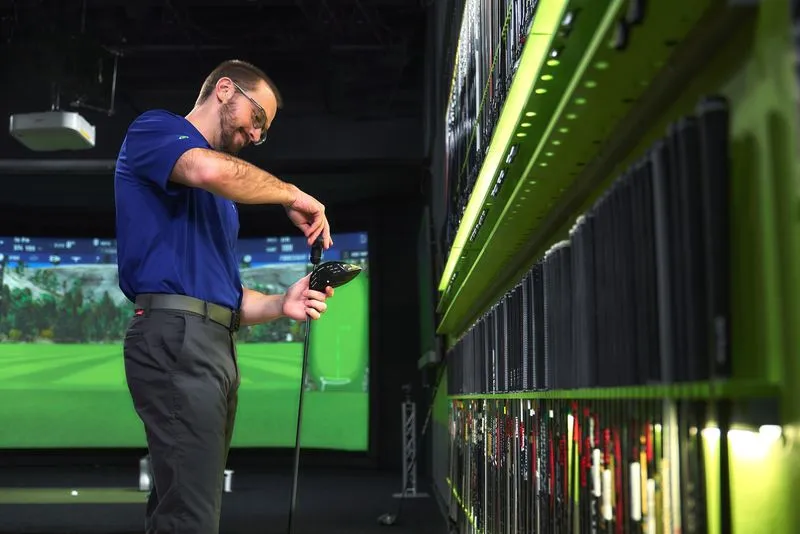
See what makes a GOLFTEC Swing Evaluation the best way to start improving your game - with personalized coaching, 3D swing analysis, and a clear plan for long-term success.
Why Augusta National Is One of the Hardest Golf Courses in the World
With a busy Singapore schedule, it is tempting to squeeze in a quick range session and work on whichever swing tip you saw most recently. Before your next round at Sentosa, ask yourself a simpler question. Do you know what you need to change, and how you will check whether your practice is working?
Spend enough time in a golf practice facility and you will notice a common theme. Most golfers have an idea that something is wrong with their game. Fewer can explain the problem with confidence.
Ask what they are working on and you might hear, "I am coming over the top", "I am flipping my hands" or "I need to get my swing more on plane". Others describe a slice, a hook or inconsistent contact. Those observations provide a starting point. A coach still needs to establish what is causing them.
The problem with assumptions
Golfers have access to an enormous amount of advice. Friends offer suggestions, social media supplies swing tips and online videos promise fixes for almost every problem.
Advice becomes harder to apply when it has been given without assessing your swing. A movement that helps your friend could be inappropriate for you. Over time, a theory about your swing can become accepted as fact without evidence to support it.
Even if you identify the problem correctly, you still need a way to make the change and practise it effectively.
Measure your swing to establish a priority
At GOLFTEC, coaches use club and ball data to investigate three fundamental areas of performance. Can you produce solid contact, generate power and control direction? More than one issue may contribute to the result.
OPTIMOTION measures how your body moves throughout the swing. Front and side video cameras help you see those movements, while comparisons with expert players provide context for your swing characteristics and measurements.
The coach's job is to turn those observations into a lesson. That means identifying a priority, choosing an appropriate change and teaching you how to practise it.
What clarity looks like for a golfer with a slice
Consider a hypothetical right-handed golfer who keeps losing drives to the right. Friends suggest releasing the club more. Online videos recommend shallowing the swing. The golfer is unsure where to start.
After watching ten drives, the coach sees that the ball starts left before curving sharply right. In this example, further investigation reveals a weak left-hand grip, shoulders aligned 15 degrees left of the target, a swing path six degrees from out to in and a clubface open relative to that path.
Those measurements give the coach a basis for deciding what to address. They might strengthen the grip, adjust alignment and introduce a more horizontal swing feel, encouraging the golfer to send the energy further right.
An analogy such as delivering an inswinging corner kick in football may help the golfer visualise the movement. An angled pool noodle could provide a physical constraint for the drill.
These are possible coaching choices for this example. Your coach selects the task and the amount of exaggeration according to your own measurements.
As the golfer works on the task, the coach can check whether the path moves away from six degrees out to in, the face becomes less open relative to the path and the rightward curvature reduces. The golfer can see whether the change is working.
Know how to practise between lessons
A successful lesson needs to lead to practice you can repeat independently. At GOLFTEC, students can work on the drills and constraints introduced by their coach, using video feedback and club data to monitor the intended change.
Singapore's heat, humidity and passing showers can make outdoor practice harder to fit around work. An indoor session gives you a chance to focus on the same task in a controlled environment, with feedback you can use straight away.
A specific objective gives each session direction. You know which movement or ball-flight result you are checking, and you have feedback to show whether you are making progress.
Have you got clarity?
GOLFTEC's coaching approach follows a practical sequence. Identify and measure the problem, establish a solution and teach the student how to practise it.
If lasting improvement has been difficult, bring your questions to a coach. Explore golf lessons at GOLFTEC Singapore or book a Swing Evaluation to understand your starting point and build a clearer plan.

Play the best golf of your life. GOLFTEC Coaches use cutting-edge tech and proven methods to level up your game fast.
Book a Lesson
Play Better!