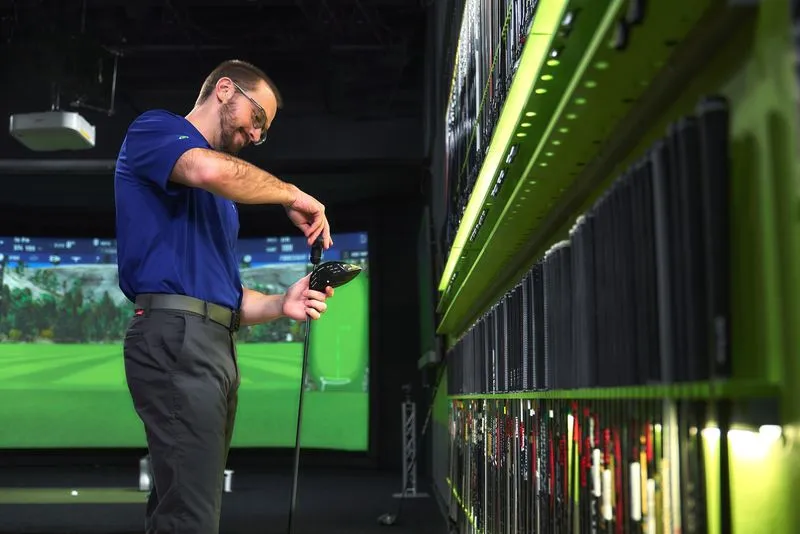

See what makes a GOLFTEC Swing Evaluation the best way to start improving your game - with personalized coaching, 3D swing analysis, and a clear plan for long-term success.
Why Augusta National Is One of the Hardest Golf Courses in the World
There is a lot that can be learned on the training centre, particularly when you have access to the technology and feedback that we use at GOLFTEC Singapore. However, golf is ultimately played on a course, where you need to make decisions, manage your misses and execute shots under different conditions. This is where an on course playing lesson with your coach can be particularly valuable. Rather than simply working on your swing, a playing lesson allows us to assess how you approach the game, identify areas where you could make better decisions and develop strategies that help you get the most out of your current ability. With so many Singapore courses rewarding smart play over raw distance, that can be worth a lot of shots.
Preparation Starts Before You Reach the First Tee
A playing lesson should begin well before you arrive at the first tee. I would always recommend getting to the golf course early enough to complete a comprehensive warm up, starting on the practice range before moving to the short game area.
On the range, we would begin with some pitch shots before gradually progressing to full swings with a shorter iron, a hybrid, a couple of fairway woods and finally a couple of drivers. The objective is not to tire ourselves out by hitting 100 balls before we even start playing. Instead, we want to loosen up, establish some rhythm and get comfortable with the feeling of the ball coming off the club face.
A great way to finish the range session is to recreate the first hole. We can identify the target, choose the club we intend to use and go through our full pre shot routine before hitting the shot. This gives us an opportunity to rehearse what we are about to do on the course, rather than simply hitting another ball into the distance. Positive visualization can help put us in a good place mentally, so when we arrive at the first tee, we already have a clear picture of what we want to do.
From there, we would head to the short game area. I like to spend time hitting shots from a variety of locations around the green, using different clubs to produce different trajectories. We might practice a stock chip with a club that allows the ball to roll more than it flies, followed by a shot with a club that carries further before releasing. We could also introduce a couple of more challenging situations, such as chipping over a bunker, to prepare for shots that might otherwise cause some anxiety during the round.
Finally, we would spend some time on the putting green. We would start with distance control to get a feel for the speed of the greens, before moving on to a few three foot putts. Seeing the ball repeatedly go into the hole can be a great way to build confidence before heading out to play.
Now we are ready to go to the course.
Making Better Decisions
Once we get onto the course, my role as a coach is to understand your plan, determine whether it makes sense and ensure that you are committing to a decision that has been properly thought through.
One of the most important things we can learn is how to account for what typically happens when you try to execute a particular shot. It is easy to visualize your best possible outcome, but good course management requires us to consider our less successful shots too.
For example, imagine that your best drives have a slight fade and finish around 220 metres. However, your worst drives tend to slice 20 metres to the right and finish around 200 metres. Does it make sense to aim down the middle of the fairway? Probably not. If your typical miss takes the ball significantly to the right, we need to consider where that ball will finish and choose a target line that gives you the best chance of keeping the ball in play.
This is where an on course lesson can be so useful. We can discuss your options before you hit the shot, establish a sensible target and evaluate the decision afterwards. Over time, the objective is for you to develop the ability to make these decisions independently, without needing your coach standing beside you.
Understanding the Value of Risk
Another important part of course management is understanding when it makes sense to take a risk and when it does not. The key is to consider both the potential reward and the consequences of a poor shot.
Imagine a golfer who can hit a three wood 200 metres, but only achieves a satisfactory result seven times out of ten. On the other three occasions, they tend to top the ball, resulting in a significant loss of distance.
If this golfer has 200 metres remaining to the hole on a par five, hitting the three wood could give them an opportunity to reach the green and set up an eagle putt. There is a clear potential reward, and the risk might be worth taking.
Now consider the same golfer with 210 metres remaining to a green guarded by a large bunker. If they cannot reliably carry the bunker, attempting the shot offers little benefit. They are likely to need another shot to reach the green anyway, so choosing a club that allows them to advance the ball safely is probably the smarter decision.
The important point is that the correct decision depends on the situation, not simply on how far you can hit a particular club. During a playing lesson, we can explore these scenarios and help you understand how to assess risk in a way that suits your game.
Getting More Out of Your Game
There are plenty of other areas we can explore during a playing lesson. We can look at how to choose the correct side of the green to miss, depending on the location of the pin and the surrounding hazards. We can discuss which short game shot gives you the best chance of getting the ball close, and we can work on reading greens to improve your ability to judge both the line and the speed of your putts.
Ultimately, the aim is not to turn you into a golfer who never makes mistakes. Golf is a difficult game, and even the best players in the world hit poor shots. Instead, we want to help you make better decisions, manage your misses and understand how to give yourself the best possible chance of scoring well.
If you think you could benefit from an on course playing lesson, speak to your GOLFTEC coach and get something booked in. You might be surprised by how much you can learn simply by taking the skills you have developed in the practice bay and applying them to the golf course.

Play the best golf of your life. GOLFTEC Coaches use cutting-edge tech and proven methods to level up your game fast.
Book a Lesson
Play Better!